Back to Top DeFi Protocols
Top DeFi Protocols
StablecoinUSDeENA

Ethena (USDe): An Overview

Ethena is the protocol behind USDe — a delta-neutral synthetic dollar that generates yield from Ethereum staking rewards and perpetual futures funding rates — offering one of the highest-yielding dollar-denominated assets in DeFi while maintaining a fundamentally different collateralisation model from all prior stablecoins.

Research DeskApr 20, 2026Reviewed by our editorial team

Quick answer

Ethena is the protocol behind USDe — a delta-neutral synthetic dollar that generates yield from Ethereum staking rewards and perpetual futures funding rates — offering one of the highest-yielding dollar-denominated assets in DeFi while maintaining a fundamentally different collateralisation model from all prior stablecoins.

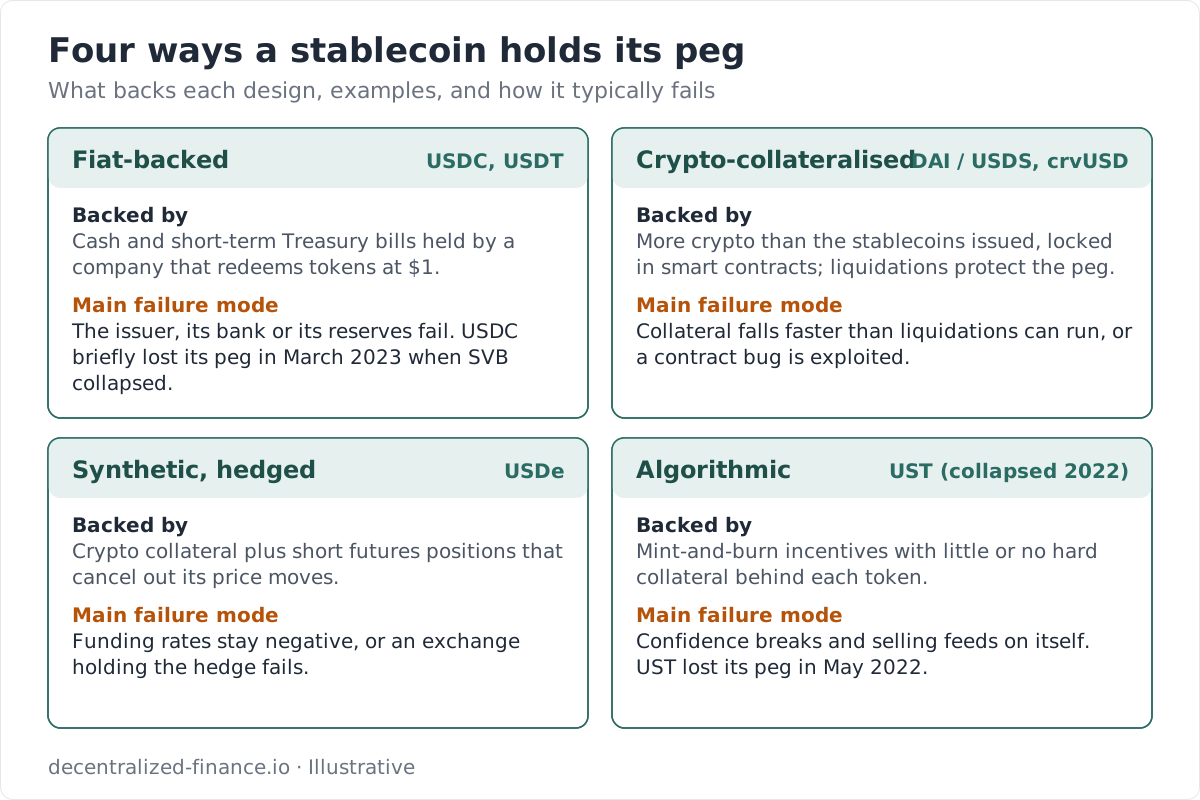
Ethena is a synthetic dollar protocol launched in early 2024 by Guy Young and the Ethena Labs team. Its primary product is USDe — a dollar-pegged token that maintains its peg not through fiat collateral (like USDC), not through overcollateralised crypto debt (like DAI), but through a delta-neutral hedging strategy: holding staked ETH as collateral while simultaneously maintaining an equivalent short position in ETH perpetual futures. The net result is a position with zero directional exposure to ETH price movements — the staked ETH gains value as ETH rises, but the short futures position loses by the same amount, and vice versa.

The design draws on the concept of a 'cash-and-carry' trade — a strategy used in traditional finance to earn the spread between a spot asset and its forward contract. In crypto markets, perpetual futures traders must pay 'funding rates' to maintain leveraged positions. When market sentiment is bullish (as it typically is in crypto), perpetual longs pay shorts — meaning Ethena's short futures positions earn funding rate income. Combined with staking rewards from the ETH backing, USDe generates a floating yield that in 2024 reached double-digit annualised returns.

How USDe Maintains Its Peg

Each USDe is backed by approximately one dollar's worth of staked ETH (held as stETH or similar liquid staking tokens) plus a short ETH perpetual position of equivalent notional value. If ETH rises by 20%, the stETH collateral gains 20% in value, but the short futures position loses 20% — the net position remains worth approximately one dollar. If ETH falls, the inverse applies. The peg is maintained by this mechanical neutrality, combined with on-chain arbitrage mechanisms that allow authorised participants to mint USDe by depositing staked ETH and redeem USDe for staked ETH.

The primary risk in Ethena's model is negative funding rates — periods when market sentiment turns bearish and short positions must pay longs. During extended bear markets, the funding income that supports USDe's yield can turn negative, requiring Ethena to draw on a reserve fund to sustain the peg. Ethena maintains an insurance fund for this purpose, and the protocol's risk management includes continuous monitoring of funding rate environments across multiple derivatives exchanges.

USDe is backed by positions on centralised derivatives exchanges — primarily Binance, Bybit, Deribit, and OKX — introducing counterparty risk with those venues. The collateral is held by regulated custodians through off-exchange settlement arrangements rather than deposited directly on the exchanges, reducing but not eliminating exchange counterparty risk.

sUSDe: The Internet Bond

Staked USDe (sUSDe) is the yield-bearing version of USDe — depositing USDe into Ethena's staking contract earns the protocol's net yield, distributed as an increasing sUSDe/USDe exchange rate. Ethena has described sUSDe as the 'Internet Bond' — an analogy to a Treasury bill but issuing on-chain and accessible globally without a brokerage account or banking relationship.

In 2024, sUSDe offered annualised yields ranging from approximately 15% to over 30% depending on market conditions — substantially higher than other dollar-denominated DeFi yield sources and dramatically higher than traditional money market instruments. This yield attracted rapid adoption, with USDe's circulating supply growing from zero to over $5 billion within its first year.

ENA Token and Governance

The ENA governance token was distributed through an airdrop to USDe holders and protocol participants in April 2024. ENA holders govern the Ethena protocol, voting on reserve fund management, collateral compositions, exchange integrations, and the introduction of new synthetic dollar products. Ethena subsequently launched USDtb — a fully collateralised stablecoin backed primarily by BlackRock's BUIDL fund — as a complementary product that provides a stable, non-yield-bearing dollar for partners and integrators who require a simpler collateral profile.

Ethena's rapid growth positioned it as one of the most significant new stablecoin entrants in DeFi history. By combining the yield advantages of a basis trade with an accessible DeFi token interface, Ethena demonstrated that there is massive demand for dollar-denominated yield products that do not require users to interact with centralised brokers or accept the counterparty risk of bank deposits.

FAQ

Frequently Asked Questions

What is Ethena (USDe)?

Ethena is the protocol behind USDe — a delta-neutral synthetic dollar that generates yield from Ethereum staking rewards and perpetual futures funding rates — offering one of the highest-yielding dollar-denominated assets in DeFi while maintaining a fundamentally different collateralisation model from all prior stablecoins.

How does Ethena (USDe) work?

Ethena (USDe) operates through smart contracts deployed on the Ethereum blockchain. Users interact directly with the protocol via a web interface or wallet integration — no account creation or KYC is required. All operations are settled on-chain and are publicly verifiable.

Is Ethena (USDe) safe to use?

Ethena (USDe) has undergone smart contract audits and is among the more established protocols in DeFi. However, all DeFi protocols carry inherent risks including smart contract vulnerabilities, oracle failures, and liquidation risk. Users should only commit funds they can afford to lose and review the protocol's audit reports before participating.

What blockchain is Ethena (USDe) built on?

Ethena (USDe) is primarily deployed on Ethereum. Many leading DeFi protocols are also expanding to Layer-2 networks such as Arbitrum, Optimism, and Base to reduce transaction costs and improve throughput.

What are the risks of using Ethena (USDe)?

Key risks include smart contract exploits, governance attacks, oracle manipulation, liquidity crises, and regulatory uncertainty. DeFi protocols are uninsured — losses from exploits are typically not recoverable. Always review audits and understand the mechanism before depositing funds.

How do I get started with Ethena (USDe)?

To use Ethena (USDe), you need a self-custody wallet (such as MetaMask or Rabby), ETH for gas fees, and the relevant tokens for the action you want to perform. Visit the official protocol interface, connect your wallet, and follow the on-screen steps. Start with a small amount to familiarise yourself with the UX.

What token does Ethena (USDe) use?

Ethena (USDe) typically has a native governance token that allows holders to vote on protocol parameters, fee structures, and treasury allocations. Check the protocol's documentation for the current token ticker, total supply, and distribution schedule.

Who created Ethena (USDe)?

Ethena (USDe) was founded by a team of blockchain developers and DeFi researchers. The protocol is typically governed by a decentralised autonomous organisation (DAO), meaning ongoing development and parameter changes are decided collectively by token holders rather than a central company.

What is the total value locked (TVL) in Ethena (USDe)?

Ethena (USDe)'s TVL fluctuates with market conditions and can be tracked in real time on DeFiLlama (defillama.com). TVL measures the total value of assets deposited into the protocol and is a key indicator of user confidence and liquidity depth.

How does Ethena (USDe) compare to other DeFi protocols?

Ethena (USDe) is differentiated by its specific mechanism, fee structure, and supported assets. Comparing protocols should include factors such as audited security posture, capital efficiency, governance maturity, cross-chain availability, and historical uptime. DeFiLlama and Dune Analytics provide side-by-side comparative data.

StablecoinUSDeENASynthetic DollarDelta NeutralDeFiYield