Sky Dollar (USDS): MakerDAO's Rebranded Stablecoin
USDS is the successor to DAI, issued by Sky Protocol (formerly MakerDAO), with $8.43B in circulation and a yield-sharing model that pays holders the Sky Savings Rate directly on-chain.
Free · Editorially independent
Editorial policyDAI is a decentralized stablecoin created by MakerDAO, backed by on-chain cryptocurrency collateral through an over-collateralized model that maintains a 1:1 peg to the US dollar.
Skip this DAI Stablecoin Stablecoin Explained page if you wanted a permissionless farm or a how-to to mint a Treasury token. It explains the peg and issuer design. Eligibility and redemptions still sit with the issuer.
Related comparisons
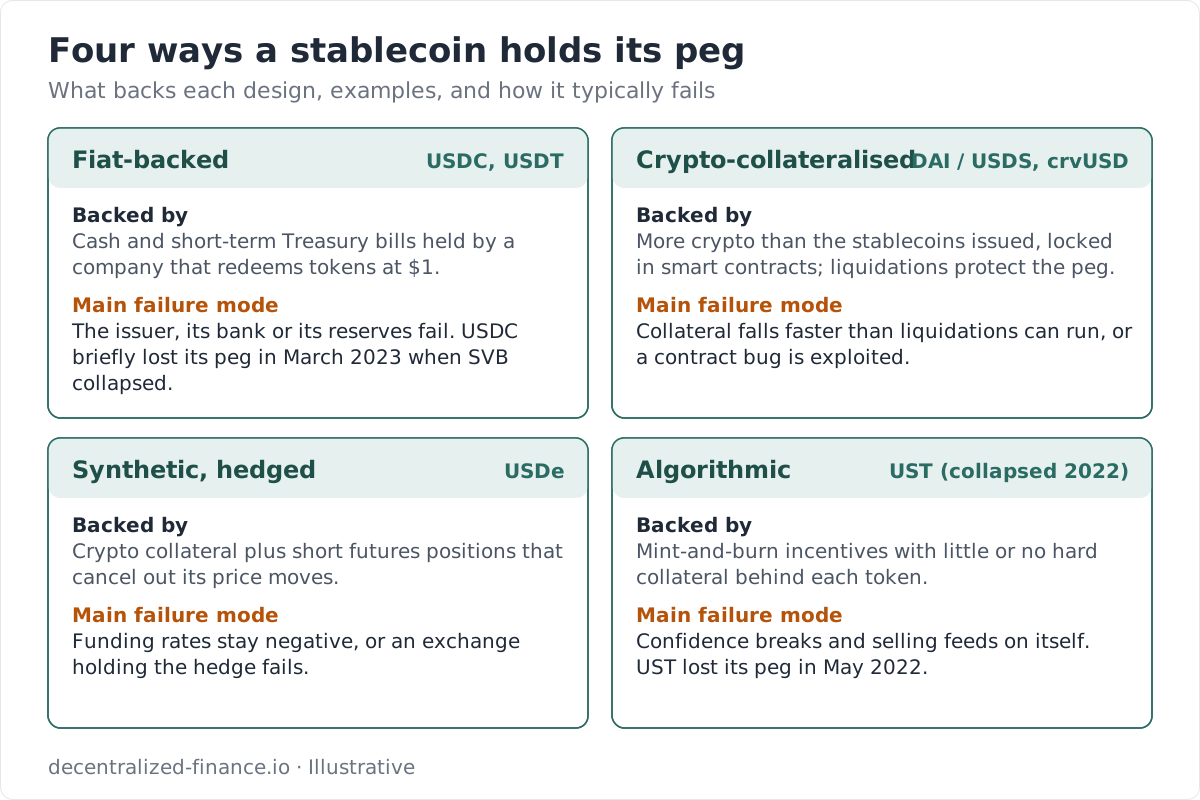
DAI is a decentralized stablecoin created by MakerDAO on the Ethereum blockchain. Unlike traditional stablecoins like USDT, which are backed by fiat reserves held by centralized entities, DAI is backed by on-chain collateral in the form of various cryptocurrencies. It is designed to maintain a 1:1 peg with the U.S. dollar through an over-collateralized model managed by the Maker Protocol.
The Maker Protocol allows users to generate DAI by depositing supported assets, like ETH or other cryptocurrencies, into Vaults (formerly known as Collateralized Debt Positions or CDPs). Users lock their assets as collateral to mint DAI, which can be freely used or traded. To protect DAI's stability, the protocol enforces over-collateralization, ensuring that the value of the collateral exceeds the amount of DAI minted. If the value of the collateral falls too low, the Maker Protocol triggers liquidations to maintain the peg.
The MakerDAO system is governed by MKR token holders. MKR serves both as a governance token and a value-capture mechanism. MKR holders participate in key decisions, including risk parameters, stability fees (interest rates), and the addition of new collateral types. Governance votes ensure that the community maintains control over the protocol's stability and ongoing development. Additionally, MKR acts as a buffer in times of system shortfalls, as the protocol can mint MKR to recapitalize the system.
DAI plays a crucial role in DeFi and has several prominent use cases:
DAI has proven itself as a robust and reliable decentralized stablecoin, enabling users to access a dollar-pegged asset without relying on centralized entities. Its over-collateralized model, community-driven governance, and wide integration across the DeFi ecosystem make it a cornerstone of decentralized finance. As the DeFi landscape evolves, DAI's role as a trusted and decentralized stablecoin is expected to grow further.
Convex, Curve, Resupply, Inverse Finance and Frax share collateral, gauges and stablecoin rails. Read the flywheel first if you are new to the stack.
FAQ
DAI is a decentralized stablecoin created by MakerDAO, backed by on-chain cryptocurrency collateral through an over-collateralized model that maintains a 1:1 peg to the US dollar.
DAI Stablecoin Stablecoin maintains its dollar peg through over-collateralised crypto assets or fiat reserves. The specific mechanism — whether over-collateralisation, algorithmic rebasing, or fiat-backed reserves — determines its stability profile, capital efficiency, and risk characteristics. Full details are available in the protocol's documentation.
That depends on the type of stablecoin. Fiat-backed stablecoins hold cash or cash-equivalent reserves at a 1:1 ratio. Crypto-backed stablecoins like DAI are over-collateralised and hold more collateral than the stablecoins issued. Algorithmic stablecoins may not hold 1:1 reserves at all times. Check DAI Stablecoin Stablecoin's official documentation for the exact backing structure.
DAI Stablecoin Stablecoin's collateral composition is defined in its smart contract parameters and may include cryptocurrencies, tokenised real-world assets, or fiat-equivalent deposits. The current collateral breakdown is typically published in real time via the protocol's dashboard or on-chain analytics tools such as DeFiLlama.
No stablecoin is entirely risk-free. DAI Stablecoin Stablecoin carries risks specific to its peg mechanism, including collateral volatility, oracle failure, smart contract vulnerabilities, and regulatory action against its issuer or backing assets. Reviewing audit reports and understanding the peg mechanism is essential before holding significant amounts.
Risks include de-pegging events (where the stablecoin trades above or below $1), smart contract exploits, collateral liquidations, issuer insolvency (for fiat-backed variants), and regulatory restrictions. Historical de-peg events in the stablecoin market — including the collapse of TerraUSD in 2022 — underscore the importance of understanding each stablecoin's mechanism before committing capital.
DAI Stablecoin Stablecoin can typically be acquired on decentralised exchanges (such as Uniswap or Curve Finance) or centralised exchanges. Some stablecoins can also be minted directly through the issuing protocol by depositing the required collateral. Check CoinMarketCap or CoinGecko for a list of exchanges listing DAI Stablecoin Stablecoin.
DAI Stablecoin Stablecoin can be deposited into lending protocols such as Aave or Compound, supplied to DEX liquidity pools on Uniswap or Curve, or staked in the issuing protocol for protocol rewards. Yield rates fluctuate based on supply and demand. Always compare rates on aggregators like DeFiLlama's yield tracker before committing funds.
DAI Stablecoin Stablecoin was created by a team of blockchain developers or a decentralised protocol. Some stablecoins are issued by regulated companies (Circle issues USDC; Tether issues USDT), while others such as DAI are governed by a decentralised autonomous organisation (MakerDAO). Check the official DAI Stablecoin Stablecoin website for publisher information.
USDT (Tether) and USDC (Circle) are the two largest stablecoins by market capitalisation and are both fiat-backed. DAI Stablecoin Stablecoin may differ in its collateral type, decentralisation level, transparency, supported chains, and regulatory status. Decentralised stablecoins like DAI or USDe offer censorship resistance that fiat-backed alternatives cannot provide, at the cost of greater complexity and different risk exposures.
USDS is the successor to DAI, issued by Sky Protocol (formerly MakerDAO), with $8.43B in circulation and a yield-sharing model that pays holders the Sky Savings Rate directly on-chain.
apxUSD is an over-collateralized, decentralized stablecoin pegged to the U.S. dollar that forms part of the Apyx Finance ecosystem. Holders can earn native yield by deploying the protocol's collateral across various on- and off-chain strategies while using apxUSD in DeFi.
Agora is a crypto startup developing AUSD, a fully collateralized, freely tradeable digital dollar stablecoin, focused on security, transparency, and efficient partner-oriented economics to serve international markets outside the United States.