Free calculator · Lending
Aave health factor calculator
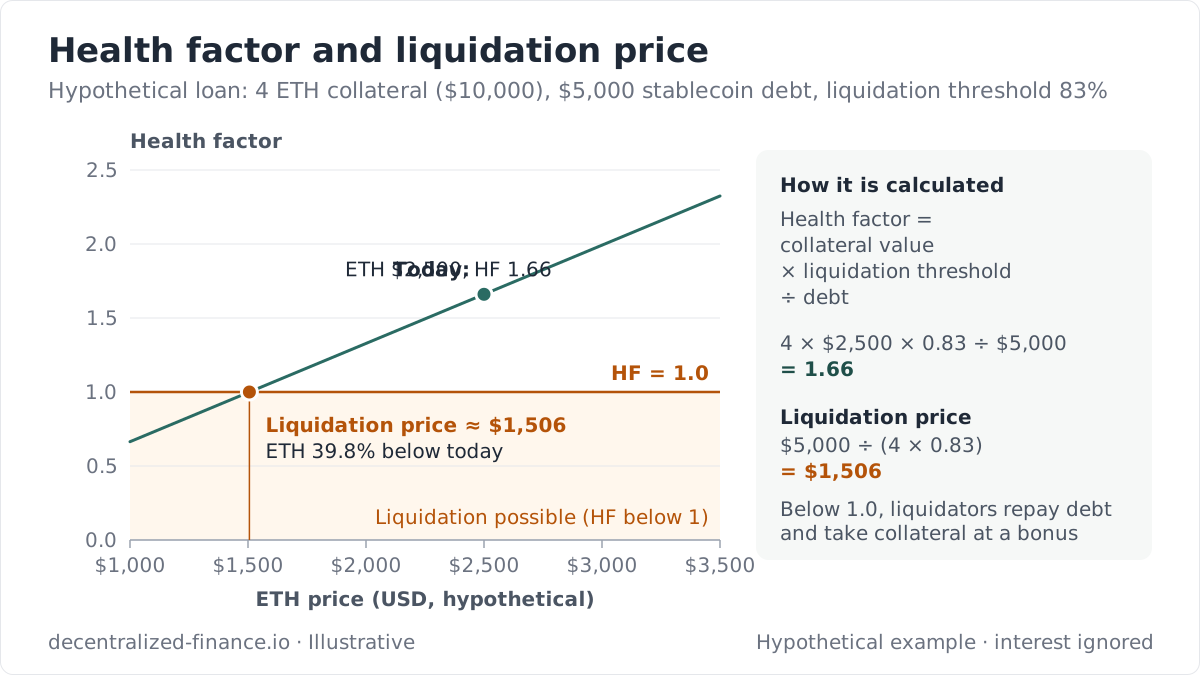
Aave's health factor is your collateral value multiplied by each asset's liquidation threshold, divided by your total debt. Below 1, the position can be liquidated. For example, $10,000 of ETH with an 83% threshold backing $5,000 of stablecoin debt gives 1.66, so ETH could fall about 39.8% before liquidation.
Published 25 September 2026 · Educational tool, not financial advice · No wallet connection needed
Calculate your health factor
Up to three collateral assets. Debt is treated as a stablecoin with a constant dollar value.
Result
Updates as you type. The health factor is rounded down to two decimals.
Default example (hypothetical position): $10,000 of ETH at $4,000, 83% threshold, 80.5% LTV, $5,000 debt.
- Health factor
- 1.66
- Total collateral
- $10,000.00
- Weighted liquidation threshold
- 83.00%
- Debt at which health factor hits 1
- $8,300.00
- Borrowing capacity used (of $8,050.00)
- 62.11%
- Fall in all collateral prices to liquidation
- 39.76%
- Rise in debt value to liquidation
- 66.00%
- ETH liquidation price (−39.76%)
- $2,409.64
Above 1, but that is a distance to liquidation, not a safety rating: a 39.76% fall in all collateral prices would reach it.
Uses the values you enter, not live on-chain data. Your real health factor is the one shown in the Aave app for your address.
Worked example (hypothetical): ETH collateral, stablecoin debt
Suppose you supply 2.5 ETH at a hypothetical price of $4,000, which is $10,000 of collateral, and borrow $5,000 of USDC. The example uses an 83% liquidation threshold and 80.5% LTV, the WETH values in Aave v3's Ethereum Core market on 25 September 2026 (see the table below).
- Threshold-adjusted collateral: $10,000 × 83% = $8,300.
- Health factor: $8,300 ÷ $5,000 = 1.66.
- Liquidation price: $4,000 × $5,000 ÷ $8,300 = $2,409.64, a 39.76% fall. At that price your 2.5 ETH is worth $6,024.10, and 83% of that equals the $5,000 debt.
- Borrowing capacity: $10,000 × 80.5% = $8,050, of which $5,000 is 62.11% used. The LTV caps new borrowing; the threshold decides liquidation.
- Debt growth: if the debt grew by 66% with ETH unchanged, through interest or because the borrowed asset's price rose, the health factor would also reach 1.
Adding a second collateral. Supply another $5,000 of USDC (78% threshold) and borrow $8,000 in total: ($8,300 + $3,900) ÷ $8,000 = 1.525, shown as 1.52. A fall of 34.43% across all collateral would reach liquidation. But because USDC does not fall with ETH, ETH alone would have to drop to $1,975.90, 50.60% below $4,000. Enter both rows above to reproduce this.
The formula, step by step
Aave's help centre defines the health factor as total collateral value times the weighted average liquidation threshold, divided by total borrow value, and says a value below 1 signals liquidation risk (Aave: health factor and liquidations).
- Value each collateral asset at the protocol's oracle price.
- Multiply each by its liquidation threshold and add them up. This threshold-adjusted collateral is the most debt the position can carry at a health factor of exactly 1.
- Divide by total debt. Health factor = Σ(collateral × threshold) ÷ debt.
- Distance to liquidation. If every collateral price falls by the same percentage, liquidation arrives after a fall of (1 − 1 ÷ health factor) × 100%. If collateral is unchanged, debt can grow by (health factor − 1) × 100%.
- Liquidation price of one asset. Holding other collateral constant: current price × (debt − other threshold-adjusted collateral) ÷ (asset value × its threshold). With a single collateral asset this is simply current price ÷ health factor.
Stablecoin debt is assumed. The calculator treats debt as a fixed dollar amount, which fits USDC, USDT or GHO borrowing while they hold their peg. If you borrow a volatile asset such as ETH, a rise in its price raises your debt and lowers your health factor, and if collateral and debt move together (for example wstETH against ETH) the price risk largely cancels. Neither case fits this model's liquidation price.
What health factor values mean
Distances assume stablecoin debt and a uniform fall across all collateral.
| Health factor | Collateral fall to 1 | What it means |
|---|---|---|
| 0.95 | Already below 1 | Liquidatable. Aave's help centre says up to 100% of the debt can be liquidated at 0.95 or below. |
| 1.00 | 0.00% | The boundary. Any further fall in collateral or rise in debt makes the position liquidatable. |
| 1.10 | 9.09% | A thin margin that one sharp move in a volatile asset can erase. |
| 1.25 | 20.00% | Collateral can fall by a fifth before liquidation. |
| 1.50 | 33.33% | Collateral can fall by a third. |
| 2.00 | 50.00% | Collateral can halve. |
| 3.00 | 66.67% | Collateral can fall by two-thirds. |
Example Aave v3 parameters (as of September 2026)
Aave v3 Ethereum Core market, standard mode (not E-Mode), read from Aave's official v3 data API on 25 September 2026. The liquidation bonus is the extra collateral a liquidator receives.
| Asset | Max LTV | Liquidation threshold | Liquidation bonus |
|---|---|---|---|
| WETH | 80.50% | 83.00% | 5.00% |
| wstETH | 78.50% | 81.00% | 6.00% |
| WBTC | 73.00% | 78.00% | 5.00% |
| USDC | 75.00% | 78.00% | 4.50% |
| AAVE | 69.00% | 76.00% | 7.50% |
Sources: Aave v3 API documentation; check current values on the Aave app's Ethereum Core market page. Governance can change these parameters at any time, and other chains, other Aave markets and E-Mode categories use different ones.
What this model leaves out
- Oracle prices. Aave values positions with its price oracles, which can differ from the price on an exchange at any moment.
- Interest accrual. Borrow interest grows your debt and supply interest grows your collateral. The calculator is a snapshot.
- E-Mode. Efficiency mode applies different thresholds to assets in the same category. Enter those values instead of the standard ones.
- Isolation mode. Isolated collateral carries a debt ceiling and limits on what you can borrow. The health factor maths is the same, but your options are narrower.
- Liquidation bonus and close factor. The model shows when liquidation becomes possible, not what you lose. Aave's help centre says up to 50% of the debt can be liquidated above 0.95, and up to 100% at 0.95 or below or when the collateral or debt is worth less than $2,000. The liquidator also takes a bonus from your collateral.
- Other versions and lenders. Aave's v4 documentation describes liquidation bonuses that rise as the health factor falls, and other lending protocols set their own rules.
How to use this safely
- Copy the threshold for your exact market and mode from the Aave app. The same asset can have different values on different chains and in E-Mode.
- Work backwards from the fall you want to survive. To withstand a 50% drop with stablecoin debt, you need a health factor above 2.
- Check the liquidation price against the asset's past sharp falls, not its average day.
- Recheck after borrowing more, withdrawing collateral or leaving the position open for months while interest accrues.
- Plan how you would add collateral or repay quickly, and remember that network congestion can slow you down just when prices move fastest.
Health factor calculator FAQs
What is a good health factor on Aave?
What happens when my health factor falls below 1?
How is the liquidation price calculated?
What is the difference between LTV and liquidation threshold?
Does interest change my health factor?
Does E-Mode change the calculation?
Related guides and tools
- Health factor (glossary)
Short definition and related terms.
- Liquidation (glossary)
What happens when collateral is sold.
- Loan-to-value (glossary)
How borrowing limits are set.
- How to supply on Aave
Step-by-step guide to supplying assets.
- Aave protocol guide
Markets, governance and risks.
- DeFi lending hub
Collateral, borrowing and liquidation.
- Impermanent loss calculator
LP value versus simply holding.
- DeFi risk and net yield calculator
Collateral stress and break-even APY.
Primary source: Aave help centre, health factor and liquidations. This calculator is educational and is not financial advice.